



6 simple ways to keep your mattress fresh for spring
Now that the clocks have sprung forward, sunlight is creeping in and the weather is edging slightly warmer, it’s time to get our homes ready for spring.
While keeping a mattress fresh might not be your first thought when it comes to spring cleaning, it can make a big difference to your home.
As temperatures rise, mattresses warm up, releasing odours from moisture that has built up over winter.
This can result in a musty smell, even when you’ve just changed your bed sheets.
In fact, your mattress could be holding the equivalent of 18 pints of sweat, based on average nightly moisture levels.
We spoke to Martin Seeley, mattress expert and CEO of MattressNextDay to find out why this happens, and how you can combat it this season.
Why does a mattress hold so much sweat?
On average, people sweat around 600ml each night, so even if only a small amount of that is absorbed, it quickly adds up.
Around 20% (120ml) is absorbed each night, so this totals around 10 litres or 18 pints over the typical 3 month winter period.
Martin explains: “Every night, your mattress absorbs small amounts of sweat and humidity from the air. In winter, that moisture is likely to stay trapped because homes are less ventilated and beds stay covered for longer. Over time, it can gradually build up inside the mattress.”
Why does it matter more in spring?
April is often when the weather warms up again, with indoor temperatures rising to around 16-18°C, the mattress warms up, too.
This causes moisture trapped inside to release odours that weren’t noticeable before.
Martin explains: “Once bedrooms start warming up again in spring, the moisture that has built up will warm up too.
“This is often when people notice a musty smell, especially when they strip the bed or change the sheets.”
Research from the Sleep Foundation suggests that mattresses contain millions of bacteria and up to 10 million dust mites, thriving in warm, humid environments.
6 ways to keep your mattress fresh
As temperatures start to rise, Martin has shared a few small habits that can make a big difference in keeping your mattress fresh.
1. Let your mattress breathe each morning
Pull your duvet back for at least 20-30 minutes each morning, so any moisture that has built up overnight can evaporate.
Martine explains: “One of the simplest things I recommend is letting your mattress breathe each morning.
“If you make the bed straight away, you trap heat and moisture inside the mattress. However, leaving the duvet pulled back while you get ready gives the mattress time to dry out properly.”
2. Place your mattress in direct sunlight
If you can, move the mattress near a window or outdoors briefly while changing your bedding.
Martin explains, “If you can move the mattress near a window while changing bedding, I always recommend doing so.
“Natural daylight and fresh air help dry out moisture that has built up in the mattress fibres.
“Sunlight also creates a drier environment on the mattress surface, which makes it harder for odour-causing bacteria and dust mites to thrive.
“Even leaving the mattress in daylight for a short time while you change the sheets can help freshen it.”
3. Open a window when you change your bedding
Fresh air can help to remove humidity that can linger in bedding and mattresses.
Martin explains: “Whenever you change your sheets, I’d suggest opening a window for a short time. Allowing fresh air in helps remove the humidity that can linger in bedding and mattresses.”

4. Sprinkle baking soda on the mattress before vacuuming
Baking soda can help to absorb odours that are trapped in the fabric. Lightly sprinkle it over the mattress, leave it for 30-60 minutes and then remove it with a vacuum using an upholstery attachment.
5. Rotate your mattress every three months
Over time, the same area of your mattress absorbs most of your body weight, heat and moisture.
Martin adds: “I usually recommend rotating your mattress every three months, using the change in seasons as a cue.
“Most people sleep in the same position each night, which means the same area of the mattress absorbs the most weight, heat and moisture.
“Rotating it spreads that wear more evenly and gives the mattress a better chance to air out.
He adds, “Memory foam and hybrid mattresses should usually be rotated rather than flipped, while some traditional pocket spring mattresses can be flipped if the manufacturer recommends it.”
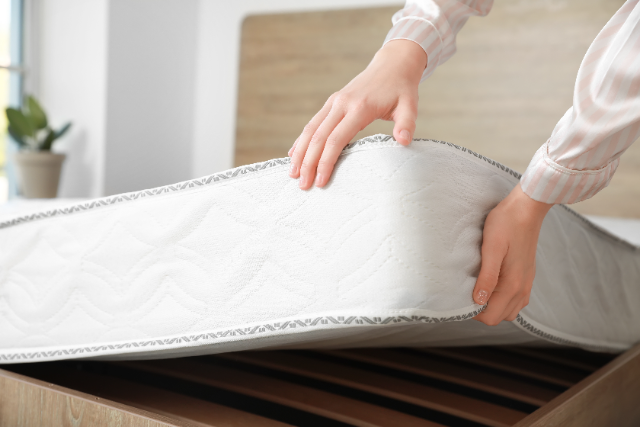
6. Use a breathable mattress protector
A mattress protector can also prevent odours from building up in the first place by stopping sweat, body oils and dead skin from soaking directly into the mattress.
However, many people still sleep without one.
Research from the National Bed Federation found that 51% of people don’t use a mattress protector, which is concerning.
Martin adds: “A mattress is a big investment, but without protection it absorbs sweats, oils and skin cells every night.
“That’s why I always recommend using a breathable mattress protector.
“It acts as a barrier that helps to keep moisture and debris out of the mattress itself, which not only keeps it fresher but also helps to extend it’s lifespan.”
READ MORE: